


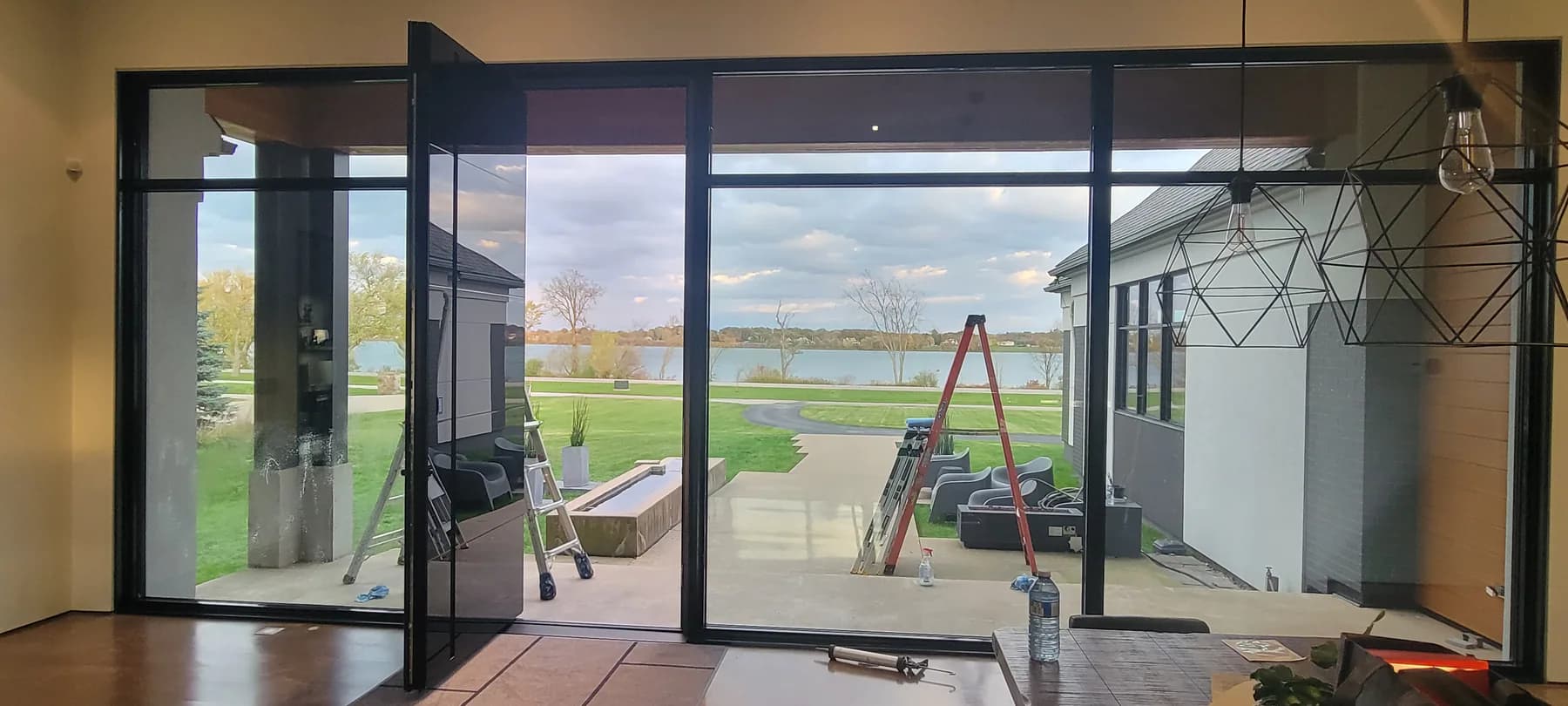
A pivot door is the fastest way to give a house a front entrance that people remember. The panel is bigger than a standard front door, there are no hinges on show, and it swings open with a light push. We have installed pivot doors on new custom homes and on renovations across the GTA, from a matte black glass entrance to marble-look and wood-slat doors.
This guide covers what we walk homeowners through before they order: how a pivot door works, how big it can be, what affects the price, how to plan the opening, and what to ask about winter performance.
What is a pivot door?
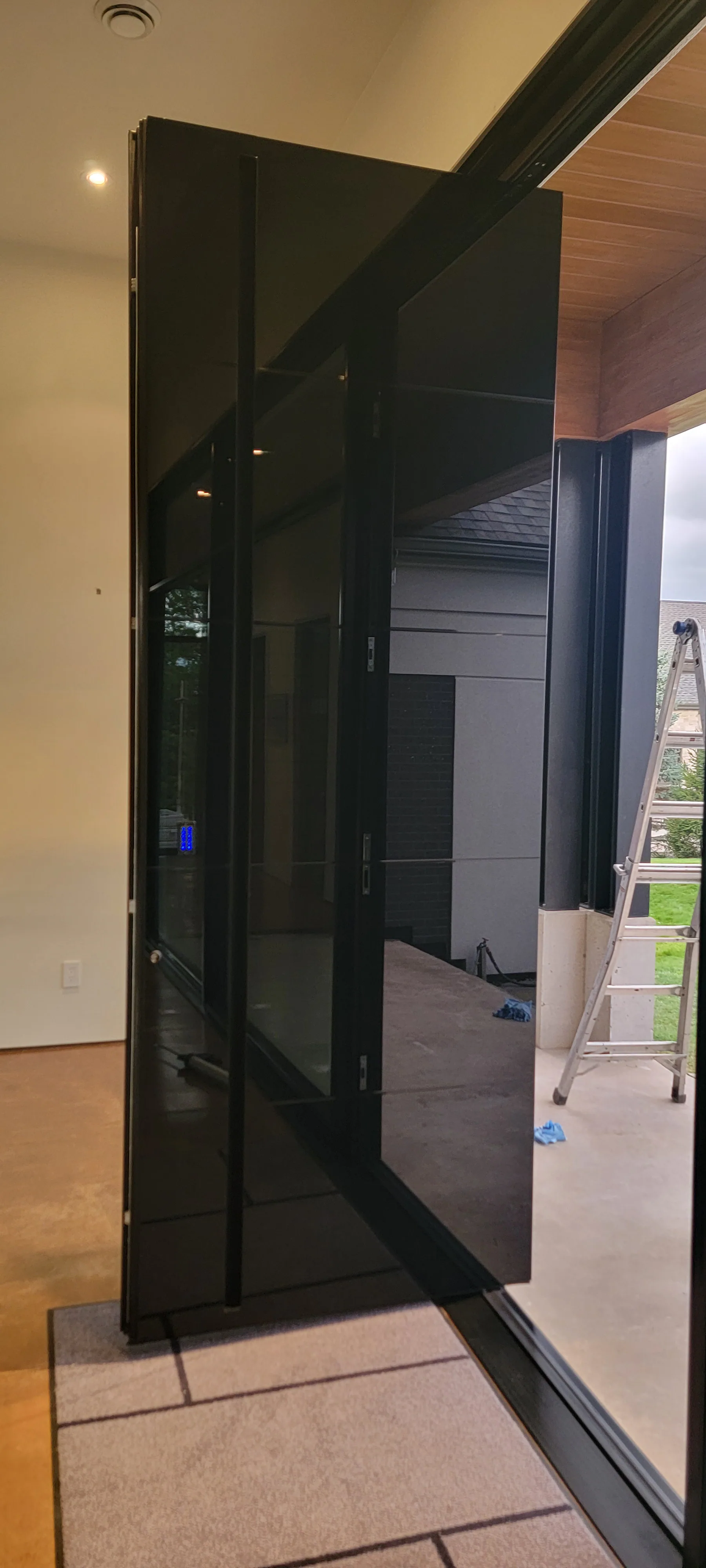
A regular front door hangs on hinges along one side. A pivot door turns on a pivot set into the floor and into the top of the frame, a little in from the edge of the door. Because the door turns around that point, part of the panel swings into the house and part swings out.
That one change is what makes pivot doors different:
- They can be much larger. The weight sits on the floor pivot instead of hanging off side hinges, so the door can be wider, taller and heavier than a hinged door. Pivot doors can be made up to about 4 m (13 ft) tall.
- They open with a light push, even when oversized.
- There are no visible hinges, so the door reads as one clean slab.
- They need clear space on both sides of the pivot, inside and out. That affects where you put the mat, the bench and the light switch.
Pivot door or hinged front door?
Pivot door
- Turns on a floor and top pivot, set in from the edge
- Oversized panels, up to about 4 m (13 ft) tall
- No visible hinges, one large slab
- Best for new builds, modern homes and oversized openings
- The higher-budget option
Hinged (swing) door
- Hinged on one side
- Standard sizes, or a pair of doors for extra width
- Classic or modern, with the widest choice of styles
- Best for replacing an existing front door in its frame
- Often the more budget-friendly choice
If you are replacing a front door in an existing frame and want to keep costs down, a steel or fiberglass swing door is usually the better fit. If the entrance is a design feature of the house, or the opening is larger than a standard door, a pivot door is worth the conversation.
How big can a pivot door be?
Pivot doors are made to measure, so the size follows the opening. A standard front door is about 3 ft wide and 6 ft 8 in tall. Many of the pivot doors we install are well over that height, and some sit in a wall of glass or between tall sidelites.
Size and weight go together. A taller, wider panel needs the right pivot hardware, a floor that can carry it, and a header that is straight and solid. That is why we look at the opening before talking about the door.
Planning the opening
On a new build, the best time to plan a pivot door is before the final floor goes in. The floor pivot sits in a recess in the floor, so the finished floor height, the threshold and the structure under the door all need to line up. We can work from your drawings and coordinate with your builder.
On a renovation, a pivot door can often replace an existing entrance, but it usually means more than swapping the slab. Expect us to look at:
- The rough opening: width, height, and whether the header is level and strong enough
- The floor: what is under the door and how the pivot will be set into it
- Swing space inside and out, including steps, railings and the porch
- Sidelites or a transom, if you want glass beside or above the door
- Power for a keypad or smart lock, if you want keyless entry
Send us photos of the entrance from inside and outside, rough measurements if you have them, and a photo of a style you like. That is enough for a first conversation.
Pivot doors in a Toronto winter
Winter is the question we hear most. A pivot door turns at a point inside its width, so the way it seals at the edges, top and bottom is different from a hinged door. Good pivot systems handle this with seals around the full perimeter and at the bottom of the door, and a well-detailed threshold.
The premium aluminium door systems we supply are built with cold weather in mind:
- Insulated frames. The frame profiles are completely filled with polyurethane foam. The frame is usually where a door loses the most heat, so filling it improves insulation, cuts outside noise and reduces condensation.
- Tested performance. The best-insulated door line we supply is rated at a thermal transmittance (Ud) of 0.82 W/(m²·K), and reaches Class 4 for air permeability, the tightest class in the European test. Ratings vary with door size, glass and design, so ask for the numbers for your door.
- Triple glazing. Glass in the door, sidelites and transoms is triple glazed, and all standard glass is laminated.
What to ask about any pivot door before you buy:
- How does it seal at the top, bottom and both edges?
- What is inside the panel and the frame, and what are its tested insulation and air-tightness ratings?
- How will the gap between the frame and the house be sealed and insulated during installation?
- Is the entrance covered? A porch roof or recess protects any front door from driving rain and snow.
Finishes, glass and handles
Most of the pivot doors we supply are aluminium, with a wide choice of faces:
- Textured colours: powder-coated finishes in black, anthracite, greys and about 50 more RAL colours
- Wood and metal looks: wood grains, concrete, copper, corten and gold-tone metal looks
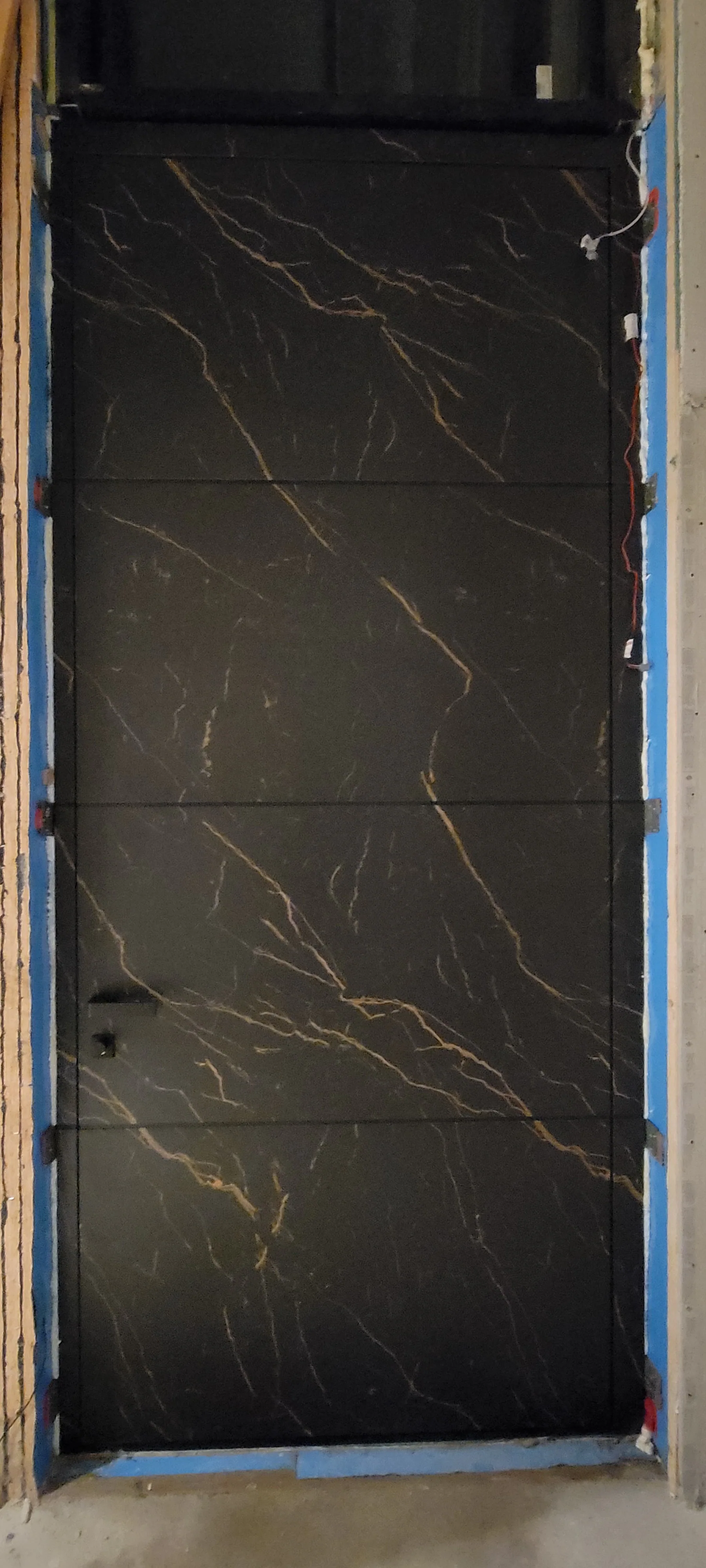
- Stone and marble looks: large panels in a stone, marble or ceramic finish
- Glass facings: black or white laminated glass for a glossy, easy-to-clean face
- Two faces: the inside can differ from the outside. One of our pivot doors is black outside and white marble-look inside.
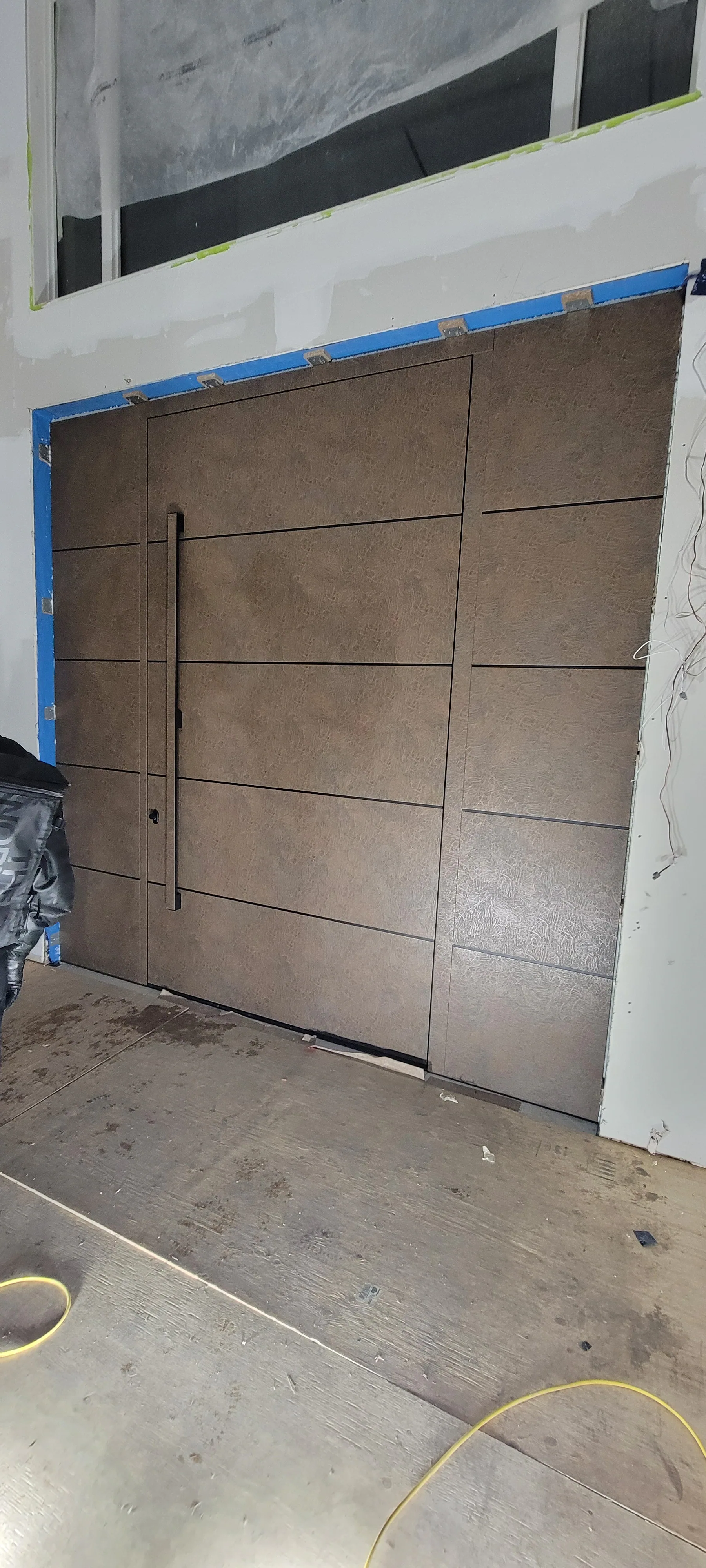
Popular designs include vertical wood slats, fluted panels, thin horizontal metal lines, a single flush slab with a full-height pull, and a vertical glass strip that brings daylight into the hall. Pulls run from about 40 cm up to 3 m long, and a full-height pull is the signature look on a pivot door.
You can browse the styles, finishes and handles in our entry door design guide.
Keyless entry and security
Pivot doors pair well with keyless entry. Our wood-slat pivot door in Mississauga opens with a keypad built into the frame, and a fingerprint reader can be built right into the pull handle. Phone-app control is also available.
On the door systems we supply, security goes beyond the handle:
- Multi-point locking. Three-point or five-point locks, including automatic locks that engage when the door closes.
- Burglar-resistance ratings. Lines are tested to the European RC2 burglar-resistance class, with an RC3 upgrade on some.
- Security glass. Laminated glass as standard, with thicker multi-layer security glass available.
- Extras. Electric door release, a digital peephole and key or knob cylinders.
Locking and security options depend on the door line and design, so we confirm them with your quote.
What affects the price of a pivot door?
Every pivot door is made to measure and quoted for the opening, so there is no single price. These are the things that move the number most:
- Size. Taller and wider panels need more material and stronger hardware.
- Finish. Textured colours sit at one end; stone, marble, glass facings and two-tone faces at the other.
- Glass. Sidelites, a transom, or a door set in a wall of glass add to the project.
- Hardware and locks. Long pulls, keypads, fingerprint readers and smart locks.
- The opening. New builds planned for a pivot door are simpler. Renovations may need header, floor or framing work.
- Access and finishing. Steps, tight access, trim and interior finishing around the frame.
The quickest way to a real number is a free consultation: we measure the opening, bring finish samples, and quote the door and installation together.
How a Better View pivot door project works
- Photos and a first conversation. Send photos and rough sizes, and tell us the look you want.
- Site visit. We measure the opening, check the floor and header, and bring finish samples.
- Design and quote. We confirm size, design, finish, glass, handle and locks, then quote supply and installation.
- Order. Pivot doors are made to order, so allow more time than for an off-the-shelf door. We confirm the timeline with your quote.
- Installation. We install the frame, set the pivot, hang the door, seal and insulate the opening, and check the swing and locks.
Frequently asked questions
Can a pivot door replace my existing front door? Often, yes, but it is a bigger job than a slab swap. The floor, header and swing space need to suit a pivot. If you want to keep your existing frame, a steel or fiberglass swing door is the simpler choice.
Are pivot doors hard to open? No. Because the weight sits on the floor pivot, even an oversized pivot door opens with a light push.
Do pivot doors need space on both sides? Yes. Part of the door swings in and part swings out, so plan for clear space on both sides of the pivot.
Can I see pivot doors you have installed? Yes. See our pivot door page and the pivot door photos in our project gallery.
Plan your pivot door
Send photos of your entrance, rough measurements if you have them, and a style you like, and we will set up a free consultation. Call 647-326-0613 or start on our pivot door page.
Sources and review
Prepared by Better View Solutions on October 21, 2026, from our own pivot door installations and the technical documentation for the door systems we supply. Performance figures are the manufacturer's tested values and vary with door size, glass and design.